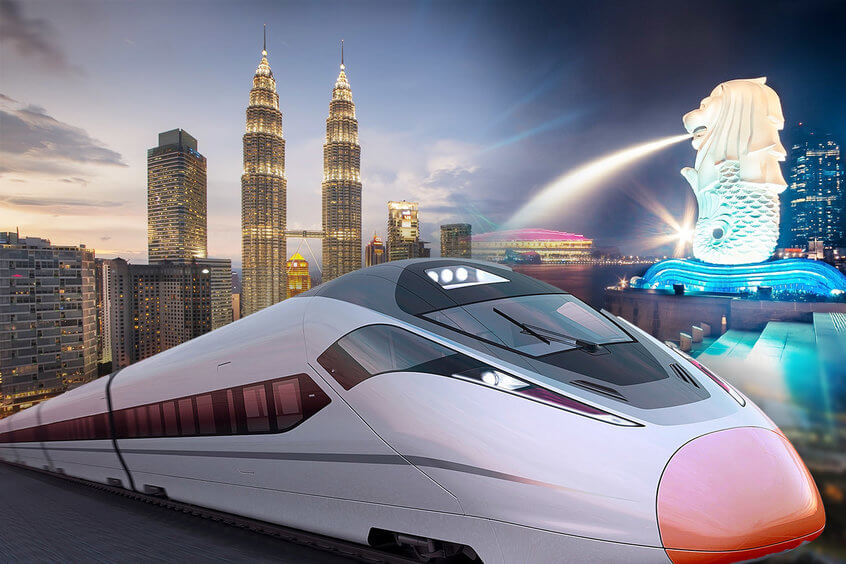
KUALA LUMPUR, 26th November – The government’s commitment to improving Malaysia’s rail infrastructure is a commendable step toward fostering national connectivity and driving economic growth. Projects like the East Coast Rail Link (ECRL) and the Gemas-Johor Baru Electrified Double Track are instrumental in bridging regional disparities and opening up new avenues for development. However, shelving the Kuala Lumpur-Singapore High-Speed Rail (HSR) indefinitely risks Malaysia losing a transformative opportunity to unlock its full economic potential and assert its leadership in Southeast Asia.
While fiscal constraints may necessitate tough choices, we must recognize that infrastructure projects like the HSR are not just about the immediate financial returns from fare collection. They represent a much larger economic narrative. The Ministry of Finance (MOF) may view the project through a lens of financial feasibility, and the Ministry of Transport (MOT) may focus on rail operations. Both are valid perspectives, but they are incomplete. A broader economic viewpoint reveals the immense potential of the HSR to catalyze growth across sectors, attract investment, and integrate key economic zones.
Take the example of the Johor Bahru Special Economic Zone—connectivity is the backbone of its success. Similarly, hubs like the Tun Razak Exchange (TRX) require seamless links to other urban centers to thrive as regional and global economic players. These considerations make it clear: the HSR isn’t merely a transport project—it’s a catalyst for economic transformation.
Globally, high-speed rail has reshaped economies. In China and France, these systems have not only reduced travel time but have also spurred the growth of new economic corridors, enhanced tourism, and fostered regional integration. The Kuala Lumpur-Singapore HSR has the potential to do the same for Malaysia. Reducing travel time to just 90 minutes between two of ASEAN’s most important cities could create a ripple effect, driving business collaborations, facilitating workforce mobility, and attracting investments that align with Malaysia’s long-term economic aspirations.
The numbers are equally compelling. The HSR’s estimated RM 70 billion cost could yield RM 250 billion in GDP growth for Malaysia alone, over 111,000 new jobs by 2060, and up to RM 19 trillion in wider economic impacts. These include new business hubs along the rail corridor and a surge in trade and tourism. Such outcomes are not attainable through fare collection alone, but they underline why this project is critical to Malaysia’s broader economic roadmap.
Delaying the HSR puts Malaysia at risk of losing its competitive edge. Our neighbours, Indonesia and Thailand, are moving forward aggressively with their high-speed rail plans. If we stand still, we risk being sidelined in the regional race for connectivity and economic leadership. The absence of a clear roadmap for the HSR sends a worrying message to investors and businesses about Malaysia’s ambition and readiness to compete.
What Malaysia needs is not just a project revival—it needs a strategy. A clear roadmap that outlines specific timelines, funding models, and regional partnerships will provide the clarity investors seek. Innovative solutions like public-private partnerships or cost-sharing agreements with Singapore could alleviate fiscal concerns. India’s high-speed rail project offers a valuable model, relying on a blend of international funding and domestic expertise to bring their vision to life.
Moreover, the HSR aligns with Malaysia’s sustainability goals by offering a low-carbon alternative to air and road travel. Its environmental benefits bolster Malaysia’s commitments to green growth and ASEAN’s shared sustainability agenda.
We commend the government’s focus on immediate infrastructure needs, but shelving the HSR indefinitely is a misstep. The HSR is not just a test of Malaysia’s ambition—it’s a cornerstone of the nation’s future. Without it, we risk watching other nations pull ahead while we remain stagnant.
The call to action is clear: Malaysia must act now to revive the HSR with a comprehensive roadmap that prioritizes connectivity, economic impact, and long-term growth. The HSR is not just about today’s challenges; it’s about tomorrow’s opportunities. Let us not settle for incremental progress when transformative change is within our grasp.
The time to lead is now. The HSR deserves to happen—not someday, but today.
End of Statement
For media inquiries, please contact:
Wan Md Hazlin Agyl bin Wan Hassan
Founder/MY Mobility Vision